
SEO meets Social: Expert interview with Dajana Doskoc

SEO continues to be a buzzword in social media marketing. People have heard of it, they know one or two terms. But they haven't yet engaged with it in any real depth. And what does it actually have to do with social media? We therefore spoke with Dajana Doskoc, SEO expert & Digital Marketing Consultant.
SEO & Social Media: An introduction
Bacon & Bold: SEO is becoming increasingly important for social media campaigns too. How can well-deployed SEO influence the performance of social media activities?
Dajana: I would like to start with an example here: brands and companies advertise their services, products, articles on exciting topics and so on via social media. Ultimately, the overriding goal is to persuade their social media community to click on the posts, for example to read articles directly on the blog, discover the latest products in the webshop or actually make a purchase.
In summary, it could be phrased as follows: in many cases (although this is of course always dependent on the campaign goal), users are redirected from a social media channel to a website or webshop. If the user who clicked on a post on Facebook cannot find their way around the page, or if the content does not match what was teased in the Facebook post, then they will likely leave the website again quickly.
Bacon & Bold: What does that mean in concrete terms?
Dajana: In short: Negative user experiences have the effect that users do not, for example, buy or claim the product or service they are interested in, and subsequently lead to a short dwell time or bring high bounce rates with them on the page. In the worst-case scenario, you lose the user or customer completely and the negative user experience remains anchored in their memory. The structure and performance of the website therefore play a major role in the success of social media campaigns.
Bacon & Bold: We naturally want to avoid the worst-case scenario as much as possible – how can we use SEO optimally?
Dajana: Search engine optimisation – SEO for short – is exactly where this comes into play! Let's assume: a link leads from social media to a landing page that convinces with high-quality content, has a long dwell time and low bounce rates. Google evaluates all these factors as quality characteristics. This also means that rankings in organic search, i.e. in Google search results, can improve.
At this point, I would like to emphasise that with SEO, it is not the search engine that is in the foreground, as is often assumed, but the user! Translated, this means that websites must first and foremost be adapted to the needs of the users. A good ranking then sets in automatically by degrees once these framework conditions are met.
Bacon & Bold: I would like to reverse the question from before here: how can good social media marketing influence or improve SEO measures?
Dajana: One thing in advance: social media should definitely be considered in every SEO strategy. In addition to on-page optimisation of the website, search engine ranking can also be optimised through off-page measures. It is simply not enough to set up the website technically perfectly and optimise all text content, photos and videos. Social media campaigns can be used in a targeted manner to draw attention to yourself and boost website performance.
Bacon & Bold: Ok, so we now know: social media marketing and SEO are closely linked. But are there any other components that sustainably influence the performance of both social media and SEO?
Dajana: Today, it is no longer about performing well in just one channel and achieving good rankings. Rather, one must utilise numerous channels simultaneously, observe interactions and coordinate and adjust measures accordingly. We are talking here about
– Earned (Organic, Press Coverage),
– Paid (Paid Search, Ads) and
– Owned Media (Corporate Content).
In my experience, it is particularly important not to view SEO as a “miracle cure”, but to see it as part of the communication strategy from the start. The same naturally also applies to social media. My clear recommendation is therefore: on-page and off-page measures must go hand in hand – and that from the beginning. What can help, for example, is a cross-channel content plan which, for example, includes events, trade fairs, conferences, but also important holidays. This way, all measures can be specifically coordinated with one another: SEO, SEA, social media, newsletter, PR, etc. This then naturally also helps in interpreting the campaign results. Keyword: monitoring and reporting as well as the correct understanding of KPIs.
SEO terms: A glossary
Bacon & Bold: You always hear a lot on the topic of backlink building – but what exactly are backlinks and what do we need them for?
Dajana: Simply explained: backlinks are references from one domain to another, i.e. links from one website to another website. One also speaks of inbound links here. The number of backlinks is often an indicator of the popularity or relevance of a website. But here, too, attention must be paid to the quality of the backlinks. If a backlink is trustworthy – e.g. comes from a “trusted domain” – and is thematically relevant, it can have a strong influence on the search engine rankings of the linked website.
Bacon & Bold: If we are already talking about the most important terminology and want to clear things up in the SEO jungle: what are so-called social signals?
Dajana: “Social signals” are defined as feedback from users that takes place via social media channels or blogs. We are talking here about likes, shares or comments.
Bacon & Bold: And what is concretely meant by the term signal building?
Dajana: In this context, people still talk about so-called link building. This is the process of building links within or outside one's own website. However, I prefer the term signal building. Concretely, it is about building a link network that leads users to my page. What was carried out to a high degree in the past, however, is to be treated with great caution today. Signal building is very time-consuming and requires a lot of prior knowledge. Ultimately, it is practically online PR for one's own brand and must be well thought out.
No need to fear Google updates
Bacon & Bold: For all SEO specialists (and those who want to become one): a hot topic: which Google updates were there this year and what do they mean for website content?
Dajana: Google has made it particularly exciting this year! After the Core Update in March, another major update for the search algorithm was rolled out in June. The most recent update is BERT. Unfortunately, Google only rarely communicates such updates in advance, which sometimes makes our work a bit more difficult. Nevertheless, I try to alleviate my clients' and partners' fears: there are an average of 500–600 Google updates per year.
Most of them are of a technical nature and are barely noticed by users and companies. Others, like the big core updates this year, specifically target the quality of the content. Google is constantly trying to improve the quality of the content presented and to encourage website operators, among other things through such updates, to focus particularly on the creation of high-quality content. Because here too, the motto applies: website content should first and foremost always be tailored to user needs.
Bacon & Bold: You mentioned the big BERT update – what does BERT do and what can we expect from it?
Dajana: BERT is an abbreviation for “Bidirectional Encoder Representations from Transformers”. It is a Natural Language Processing update. For the Google algorithm, the update is a giant step: “The biggest leap forward in the past five years”, as they announced on their own blog.
Until now, the algorithm captured words in the order typed. But BERT can now interpret search phrases or sentences or questions in a new way and thereby establish entirely new connections. Thus, every word is now compared with the one that comes before and after it. That could, for example, be relevant in particular for queries that contain a negation. With its new interpretation method, BERT comes significantly closer to what Google users are actually looking for. This is intended primarily to help users in using Google and to improve the quality and relevance of the search results massively. It will be exciting to observe how the experiences that Google is currently gathering with BERT, especially in the English-speaking world, are then also transferred to other languages.
Bacon & Bold: Let's look into the future together at the end – outlook 2020: which Google updates are currently to be expected? There is always a lot of rumour-mongering here!
Dajana: As always, it remains exciting, as Google lets very little to nothing leak out to the public. However, after the big updates this year were launched at 3-month intervals, I could very well imagine that something will happen in December 2019 or immediately at the beginning of the coming year. But one thing can be said with certainty even now: the quality of content will continue to play a major role – and that affects websites and social media content equally!
Bacon & Bold: Thank you very much for the exciting conversation and the insights!
Dajana: Thank you for the invitation!
The interview was conducted by Julia Daschütz for Bacon & Bold.
Info about the SEO expert
Dajana Doskoc is an expert in search engine optimisation (SEO). Between 2012 and 2017, she worked for, among others, the Viennese SEO agency Improove GmbH & Co KG as well as the digital unit of the Serviceplan Group, Plan.Net Austria. As a Senior SEO & Digital Marketing Consultant, she managed large national and international clients there such as A1 Telekom, Carglass Austria, Motorola Austria, Red Bull, simpliTV, Tourismusverband Pitztal and VAMED Vitality World. Since autumn 2017, Dajana has been self-employed and works closely with partner companies such as jobiqo GMBH, Huangart | digital branding and Bacon & Bold, among others. She supports her clients in the development of holistic digital communication strategies and specialises in SEO.

Conclusion
You might also like these articles

ChatGPT Ads: What Brands Need to Know
ChatGPT Ads are now available in Austria and Germany. The essentials on placement, targeting, creatives, tracking and running a first test.
The Performance Branding Framework
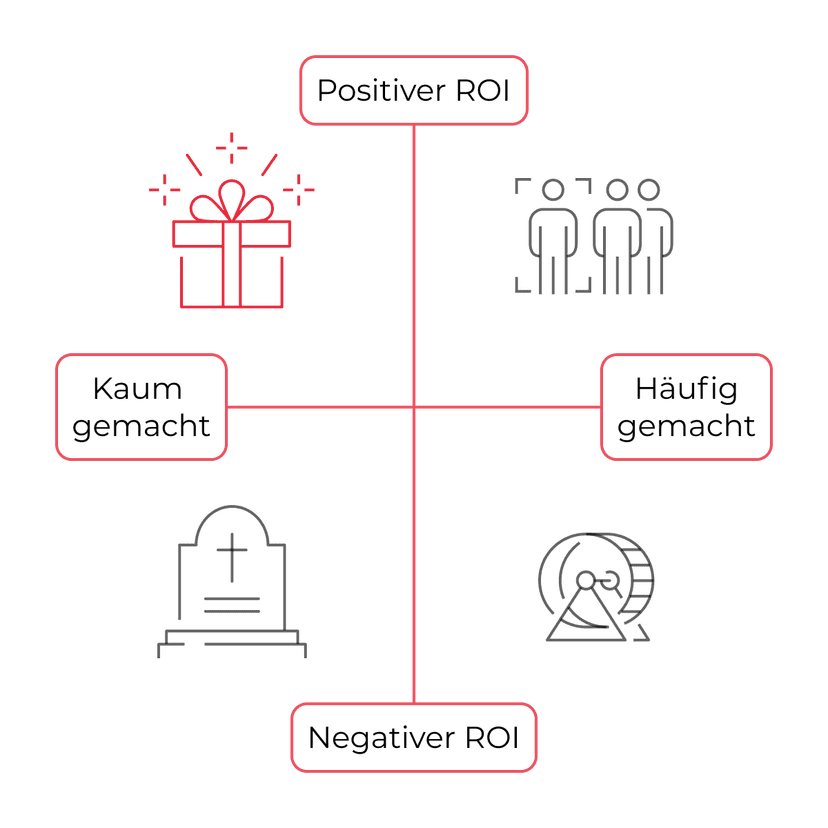
The Bacon & Bold Framework categorizes digital marketing into "Digital Basics" and "Digital Advantages", supporting optimal resource utilization and planning.
Crisis Communication on Social Media
Crisis communication on social media is a challenge, but with the right preparation and quick responses, you can prevent a lot of damage.
Still have questions?
Let’s find out where your lever is. One chat. One honest assessment.
Or write us directly at hello@baconbold.com