
These 5 mistakes media agencies make with Facebook advertising

Unfortunately, Facebook advertising is still treated very neglectfully by many media agencies, much like classic display advertising. However, this approach is often fatal and leads to vast amounts of marketing budgets being wasted every year.
This is particularly a shame on Facebook, which is, and could be, the most efficient advertising channel for many companies at the moment. It is all the more important to be able to recognise the most common errors in reporting, or ideally, before a campaign launches.
Poorly chosen optimisation goals
The most historically common optimisation goals were page likes, engagement and traffic. However, these are now usually the worst possible choices.
Page likes are no longer a relevant objective, as the logic behind them no longer adds up. Due to low organic reach, it is now significantly cheaper to simply reach the target audience a hundred times over via advertising than to gain them as fans in order to reach them organically.
Engagement was long the optimisation of choice for content promotion, but this objective optimises for the wrong target audience. When this optimisation is selected, the advertising is primarily seen by the 20-30% of users who like to interact with posts frequently. However, these are often not the highest-quality or most high-spending target group.
Traffic campaigns optimised for link clicks are only an option if a Facebook pixel cannot be used. If the pixel is implemented, you should always optimise for a relevant conversion on the website, or at least for landing page views, which ensure that the users you are paying for haven't just clicked away, but have actually arrived on the website.
Good optimisation goals, on the other hand, are e.g. conversions, video views and reach.
Incorrect target audience size
The target audience in a campaign should always depend on the available budget, the optimisation goal and the desired frequency or maximum frequency. This is important because, otherwise, the algorithm cannot do a good job, and costs for delivery will explode if too much budget is allocated to a target audience that is too small.
Two cases to illustrate these decisions:
Case 1 – Performance Marketing
There is an uncapped budget for performance marketing, and even in the pilot phase, at least €10,000 per month is to be invested for the Austrian market. Optimisation is directly for purchases in the online shop, and the average frequency should not exceed 4, as from a brand perspective, users should not be over-exposed. To define the correct target audience sizes, we begin with a simple calculation:
If we pay €5 CPM, we can achieve approximately 2,000,000 impressions with €10,000 per month. At a frequency of 4, this would mean 500,000 people/reach.
Furthermore, we are optimising for purchases and want to give the Facebook algorithm room to find people who enjoy and frequently shop online in our category. Therefore, we want to have at least 3-4 times more people in the target audience than we can reach.
This means that we need 1.5-2 million people in the targeting. In Austria, this means that we effectively need a so-called control target group that is limited only by age and language. Additionally, we can add large 10% lookalikes and broad interest target groups to the campaign.
Case 2 – Job Advertisement
We have €200 to advertise a vacancy based in the Vienna area. The frequency should not exceed 2, as we want to reach many people. The optimisation is reach, as only an image with text is to be advertised and no website is available.
If we again pay €5 CPM, we can achieve 40,000 impressions. At a frequency of 2, that means we will reach only 20,000 people.
However, Vienna has significantly more Facebook users, and optimisation for reach does not help us find the right people either, as Facebook only optimises for quantity here.
Therefore, in this case, we choose small interest target groups, e.g., people with certain relevant job titles. We thus combine target groups of a few thousand people up to a few tens of thousands in our campaign.
Too few creatives and variations
Creatives now account for well over 60% of a campaign's success, and the more automated the ad placements become, the greater their significance.
Those who believe they already know in advance what their target audience wants to see and hear are often proven wrong in performance marketing. It is not uncommon for the variant no one believed in to be the winner.
Good performance campaigns therefore constantly require a large number of different creatives, headlines and texts. Only in this way can the algorithm really get the maximum out of it – and that pays off.
If ten creatives are produced instead of one, the best creative often performs three to four times better than the average. This means that if, for example, you use a €2,500 media budget and ten creatives, you achieve the same number of results through the higher number of creatives as you would with a single creative on a €10,000 media budget.
Audience Network as a placement
This error happens most frequently with advertising that has link clicks as its goal. There, the Audience Network is often included as a placement, meaning the ad is displayed outside the Facebook apps. While the placement there is very cheap and generates many clicks, experience shows that these clicks often perform very poorly and hardly convert, or users bounce immediately.
For most campaigns, the Audience Network should not be selected. It is even worse if the Audience Network is combined with all other placements. Then it often happens that almost all advertising is displayed there. The client thinks they have received advertising on Facebook, but in the end, almost no advertising was actually run on Facebook itself. If the placements are not visible in the reporting, it can often be identified by the cheap CPM of under €1.
The Audience Network is only recommended as an option if, for example, you are optimising directly for the most important goal – such as purchases in e-commerce – and brand safety does not play a major role.
Micromanagement of campaigns
You can micromanage not only employees but also campaigns. While in the past the greatest effort lay in optimisation, today it lies in campaign structuring and the creatives.
If a campaign's optimisation is set up correctly, making changes too early often causes more harm than good. For example (depending on the daily budget and the size of the target group), you should let conversion campaigns run for at least 3-4 days before making a decision, as the algorithm needs time to find the right users.
Similarly, target groups should not be switched on and off too often. Especially with automated campaign budget optimisation, it is usually the right choice to let a target group run, even if it shows poorer results.
Often, for example, small and niche target groups are mixed with large and broad target groups in campaigns. After 2 days, it looks as if the small target groups are performing better because they are more precise, and an overzealous marketer switches off the large target groups.
What happens afterwards, however, is not considered: more and more budget is allocated to a small target group that becomes over-exposed, and costs rise rapidly. On average, it would have been significantly better to keep all target groups active.
Conclusion
When we first published this article almost 3 years ago, the points were completely different from those in today's version. Some tips from back then have now turned into the complete opposite because Facebook's algorithm has made great leaps forward.
The weighting has also changed significantly: 3 years ago, the focus was still strongly on optimisation and target audience selection; today it is much more on the creatives, the choice of optimisation and the campaign structure.
Therefore, it is more true than ever today that a good performance marketer is only as good as their last campaign. Knowledge becomes outdated rapidly in this area, which is why our agency places an enormous emphasis on constant further education and experimentation.
Conclusion
You might also like these articles

ChatGPT Ads: What Brands Need to Know
ChatGPT Ads are now available in Austria and Germany. The essentials on placement, targeting, creatives, tracking and running a first test.
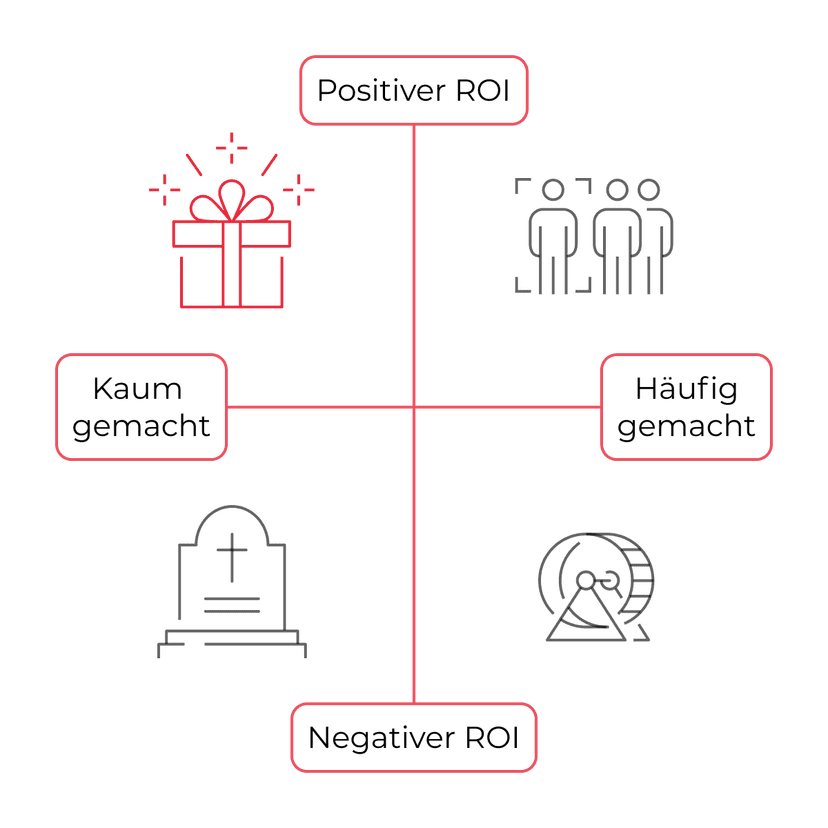
The Performance Branding Framework
The Bacon & Bold Framework categorizes digital marketing into "Digital Basics" and "Digital Advantages", supporting optimal resource utilization and planning.
Crisis Communication on Social Media
Crisis communication on social media is a challenge, but with the right preparation and quick responses, you can prevent a lot of damage.
Still have questions?
Let’s find out where your lever is. One chat. One honest assessment.
Or write us directly at hello@baconbold.com