
How-to: B2B lead campaigns on social media – Part 2

Would you like to use social media as a platform for your next B2B lead campaign? Or are you dissatisfied with your results so far on LinkedIn, Facebook and the like? Then you’ve come to the right place.
How do you set up a B2B lead campaign on social media? In this article, we go through exactly what you need to look out for, step by step. From formulating hypotheses and designing ad creative to evaluating lead quality.
The following article is the second part of our article series on this topic.
Part 1: Using social media for B2B lead campaigns
Part 2: How-to: B2B lead campaigns on social media
Part 3: Case study: Primetals Technologies
1. How do I form meaningful hypotheses for the campaign?
Even before we start writing post copy, animating videos or creating graphics, we consider what incentives might encourage potential customers to leave their contact details.
First, we need to clarify what the selling points are for the product being promoted. The ideal contact person for this is the sales team. Sales staff have direct contact with existing and new customers and are therefore best placed to provide information on what convinces customers.
The real reasons often differ from the reasons found in marketing materials. As a rule, sales teams also know what competitors are doing better or worse – whether in product design or customer support. This allows us to differentiate ourselves even more effectively.
The sales team can usually also provide excellent information about the customer structure. How large are the companies that purchase the product? Which industries are particularly well-represented? Which markets is the company active in? Where is coverage already good, and where is there potential for growth?
Based on the information gathered, hypotheses are then formulated: What prompts a potential customer to provide their contact details? This could, for example, be
- a product sheet for an innovative product
- a whitepaper
- an offer for a free consultation
- or an appointment at a trade fair.
A wide variety of existing marketing activities can therefore be utilised.
Important: This consideration serves only as a psychological trigger here. Just because, for example, the free consultation works best in the campaign, it does not mean that a product sheet cannot also be sent out during the initial contact.
Tip: In any case, you should specifically address the offer mentioned in the lead ad during the first point of contact. At the time of contact, the lead may have already forgotten that they filled out a lead form on Facebook or LinkedIn a few days ago.
2. How can these hypotheses be used?
Let's assume we have now found three incentives that could serve as consideration for a lead:
- Technology whitepaper
- Free consultation
- Invitation to the trade fair stand
Why several incentives? We want to test different approaches against each other and check which arguments resonate best with the target group. On one hand, this allows us to perform better optimisation work; on the other, we gain insights that are valuable beyond the campaign itself.
The next step is the design of ad creative that leads to these incentives. The number of ads produced depends heavily on how much explanation the product requires, the production budget, the available material and also the platforms. As a rule, however, we try to produce at least one motion-picture variant and one static variant per incentive.
Tip: LinkedIn will generally be the main channel for B2B campaigns. We have found on LinkedIn that you should not create and test too many ad variants. Unlike on Facebook, the algorithm on LinkedIn achieves better results with a smaller selection of creative.
3. How do I build a campaign?
Especially in the B2B sector, experience with digital campaigns and social media is often limited. This must be taken into account when setting up the campaign. We therefore rely on a campaign structure in which we first test different approaches against each other. We then scale the campaign.
First, we need to consider which platform is best suited for the test phase. The answer to this question will not always be the same. Facebook clearly has better tools for this (such as standardised A/B tests), while on LinkedIn we can easily reach niche target groups without too much wastage.
The duration and complexity of the test phase depend on the number of hypotheses and incentives to be tested. Overall, the rule is: Do not test too many parameters simultaneously. It is better to divide the test phase into several sub-phases or to test some of the hypotheses in the next campaign instead.
Let's assume the example chosen above with three incentives. Three ads were produced per incentive: a video animation, a static image with a photo, and a quote card (i.e., text on a coloured background). How could one proceed in this case on LinkedIn?
- One campaign per trigger in which the two static visuals are tested against each other
- An additional campaign in which all videos are tested against each other.
- All campaigns have the same target group. This target group should be very narrowly defined in order to obtain the most meaningful results possible.
(Note: This setup is chosen because on LinkedIn, videos and static ads cannot be mixed in one campaign. On Facebook, you could simply create one ad set with all assets per trigger.)
If there is sufficient budget, different target groups can also be tested in a second step. To do this, create one campaign per target group and test all static assets against each other within them.
4. How do I recognise a successful campaign?
Our primary goal is to collect as many high-quality leads as possible. Since information about the quality of the leads only arrives with a time delay, we must rely on other metrics for optimisation work in the LinkedIn Campaign Manager or Facebook Ads Manager.
The total number of leads is certainly the most valuable indicator. But values such as opened lead forms, click-through rate, cost per video view or CPM can also provide information about how well the ads are being received by the target group.
Especially with campaigns with low daily budgets for niche products, only a few leads will be collected per day. These leads can also be statistical outliers. In these cases, it is all the more important to include secondary KPIs in the evaluation.
How can the results be interpreted now? Let's go through this again using the example above:
- We compare the results of the different campaigns with the static assets to determine which incentives performed best.
- We can reconcile this result with a comparison of the different video ads in the video campaign.
- The comparison of the static campaigns and the video campaign provides information about which content format is best received.
- A look at the ad level of the static campaigns shows whether the quote cards or the ads with photos performed better. Depending on the incentive, there may be differences here.
For the main phase, we then focus on the 1-2 incentives that worked best. If there are individual ads in the campaigns that performed significantly worse, we do not carry them over to the main phase.
For the main phase, the ads are no longer sorted by incentive, but are transferred into a consolidated campaign. In addition, the target group is expanded. Now that the tests are complete, we can accept more wastage.
For real nerds: Helpful tips for B2B lead campaigns
Further tips for campaign management:
- Unfortunately, the only possible optimisation goal is "lead generation". The option on Facebook to rebuild lead forms using Instant Experiences is no longer available.
- Regular feedback from the sales team is essential: quality is more important than the number of leads. Since we cannot determine quality from our data, we must remain in constant contact. Depending on the feedback, we can then adjust, shrink or expand the target group.
- Bidding: At the beginning, we select lowest cost. If the daily budget is not being spent, gradually increase the maximum bid until budget starts to be used again.
- The LinkedIn algorithm is less mature than that of Facebook. This means that on LinkedIn, it is better to work with fewer different ad formats per campaign set.
- The following also applies: It is better to start with a narrow target group and gradually add broader target groups once the narrower one is exhausted.
- Use the platforms according to their strengths: use LinkedIn tools like List Upload for existing customers or target accounts; create target groups based on micro-interests on Facebook.
- Test, test, test: At the beginning, you never know what will appeal to niche target groups. Testing different incentives, creative lines and ad formats is unavoidable.
- If a landing page already exists that has achieved good results in lead generation in the past, it should also be tested. In many cases, better results can be achieved this way than with native lead forms on the platforms. Furthermore, valuable website data can be collected in this way.
Conclusion
From the decision to run a B2B lead campaign on social media to the launch of the campaign, it can take a long time. With the right processes, however, it can also go very quickly. Because social media – if you use the platforms correctly – brings very fast results.
In doing so, you should not forget three things in particular:
- The sales team is your most important partner for marketing in lead campaigns. Get them on board early.
- Social media is particularly well-suited for testing different approaches – this should not be forgotten in campaign planning.
- Your campaign is only as good as the quality of your leads.
You can find more on this topic in Part 1 and Part 3:
Part 1: Using social media for B2B lead campaigns
Part 2: How-to: B2B lead campaigns on social media
Part 3: Case study: Primetals Technologies
Conclusion
You might also like these articles

ChatGPT Ads: What Brands Need to Know
ChatGPT Ads are now available in Austria and Germany. The essentials on placement, targeting, creatives, tracking and running a first test.
The Performance Branding Framework
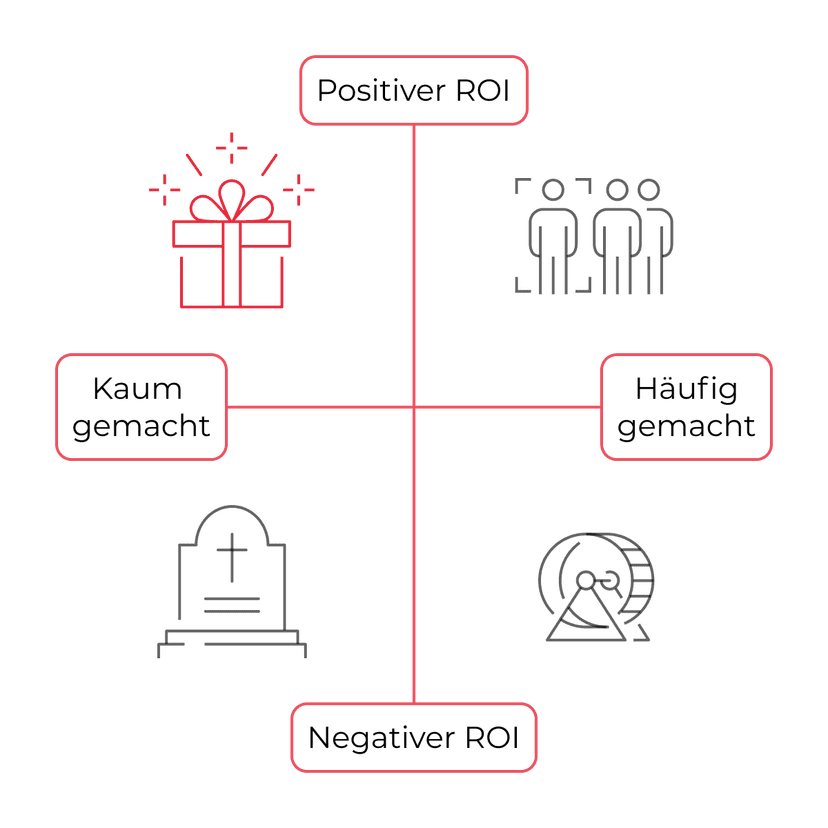
The Bacon & Bold Framework categorizes digital marketing into "Digital Basics" and "Digital Advantages", supporting optimal resource utilization and planning.
Crisis Communication on Social Media
Crisis communication on social media is a challenge, but with the right preparation and quick responses, you can prevent a lot of damage.
Still have questions?
Let’s find out where your lever is. One chat. One honest assessment.
Or write us directly at hello@baconbold.com