
Using social media for B2B lead campaigns: Introduction – Part 1

Lead campaigns on social media are an underestimated instrument in B2B marketing. Quick results, cost-effective advertising opportunities (even for manageable budgets) and global scalability are tempting incentives for any company.
Because regardless of whether you are looking for prospective customers for steel mill construction, applications for Industry 4.0 or production plants for the chemical industry: they are all active on social media and can even be reached more cheaply there than via conventional media.
We answer the most important questions about B2B lead campaigns on social media: Why should you try it? Who can be reached? What results can one expect?
The following article is the first part of our article series on the topic.
Part 1: Using social media for B2B lead campaigns
Part 2: How to: B2B lead campaigns on social media
Part 3: Case Study: Primetals Technologies
Why? B2B lead campaigns on social media
Appearances at the most important industry events. Check. A website optimised for search engines. Check. Landing pages with excellent conversion rates. Check. A well-maintained CRM. Check. Email automation. Check. Presence in trade journals through advertisements. Check. Regular, target-group-oriented posts on LinkedIn and Facebook. Check.
Despite everything, is the sales pipeline not as full as the sales team would like? Lead campaigns on social media offer the possibility to collect leads cost-effectively and in a scalable way.
And on top of that, only comparatively little preparatory work is necessary to achieve initial results. There is no need to book a trade fair stand months in advance, nor is there any need to program a website.
Are there already existing assets such as landing pages or white papers? Is an important trade fair coming up soon or is a new webinar series starting shortly? Is there a list of target customers or new target markets? All the better: We can use all of this for the lead campaign.
What are lead campaigns actually?
But back to the start. What do we actually mean when we talk about “lead campaigns”? There are basically two forms of content on social media platforms:
1. So-called organic posts, which are sent out by private individuals or company pages and are played out in the feeds of followers.
2. To avoid leaving it to chance who gets to see your own posts and also to reach users who are not already followers of your own page, advertising can also be placed. These advertising posts are similar in design to organic posts, but are marked with the addition “Sponsored”.
Who gets to see these advertising posts is determined by the advertiser. Various parameters are available to narrow down the target group. This is referred to as targeting. The parameters to be selected differ depending on the platform.
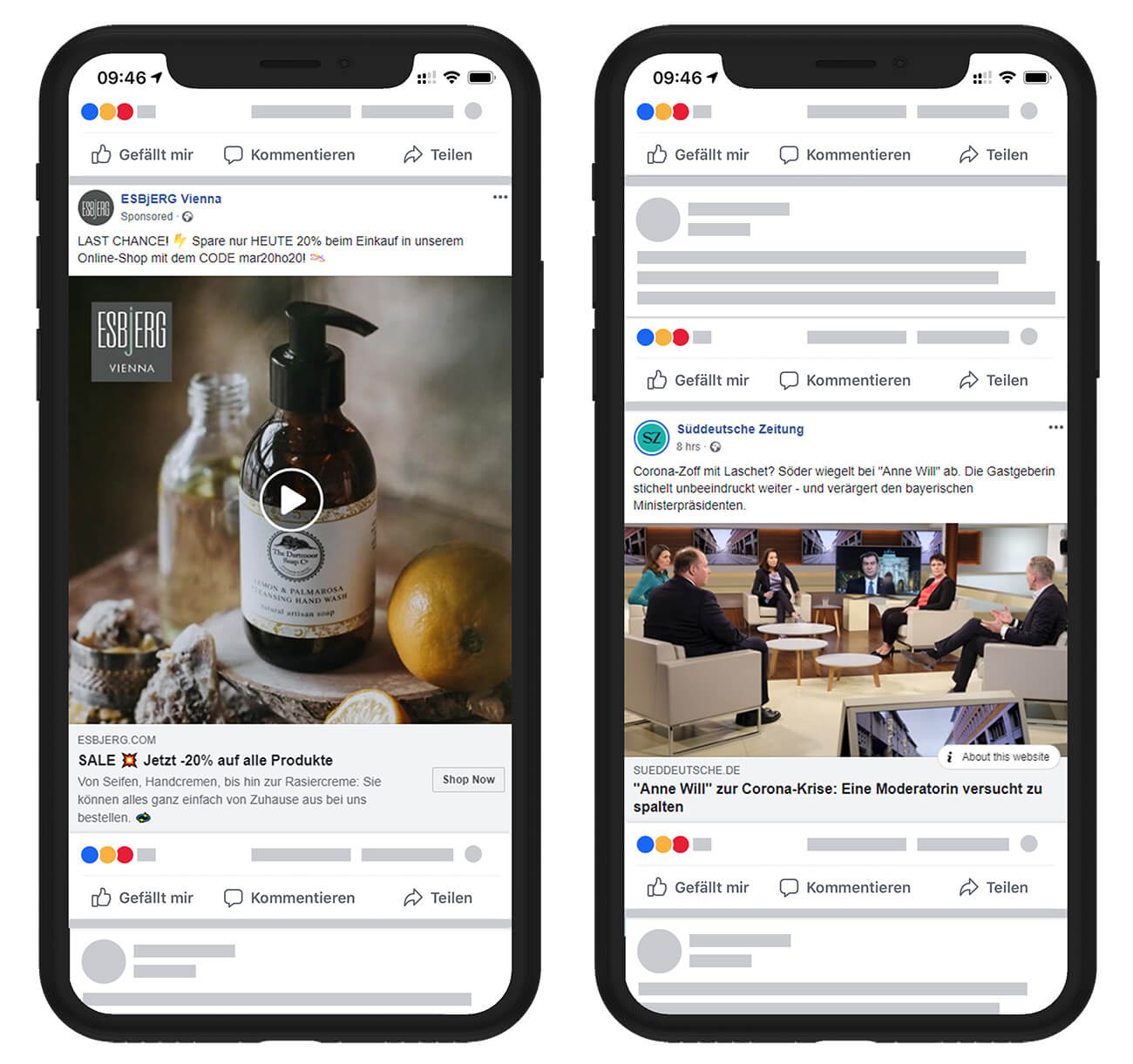
In addition to demographic criteria such as age and gender, which can be used for narrowing down practically everywhere, LinkedIn is particularly suitable for narrowing down user groups on the basis of their professional situation. On Facebook, user behaviour can be taken into account particularly well in targeting.
While social media advertising initially resembled advertising banners as known from other websites, it now offers many additional possibilities. A special feature of Facebook and LinkedIn, for example, is the possibility to run so-called lead ads.
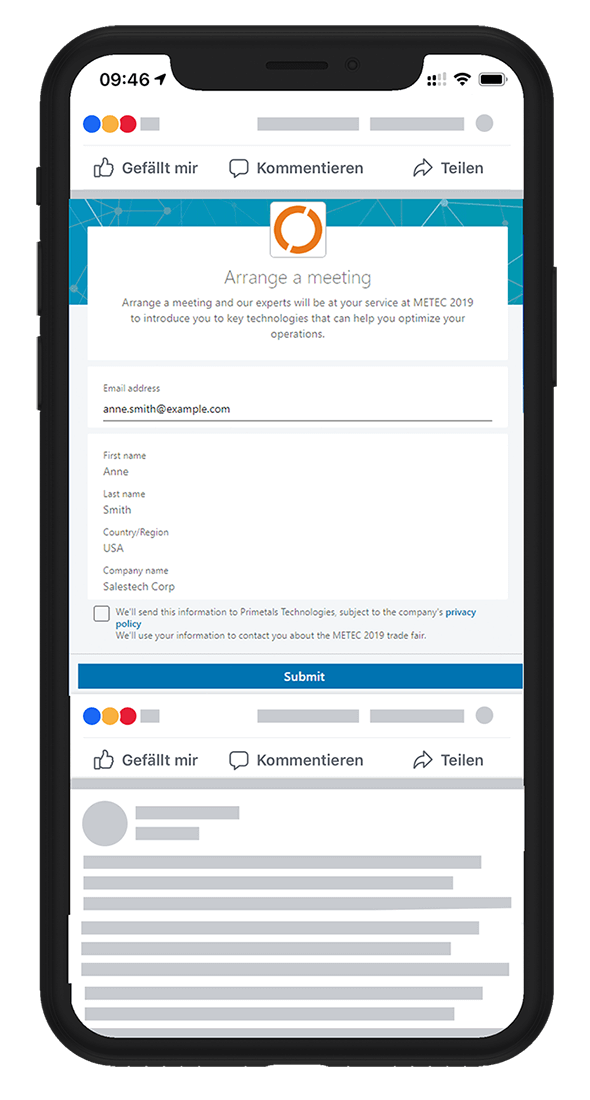
At first glance, this form of advertising hardly differs from other image posts or videos that, for example, redirect to a website or an online shop. However, clicking on the advertising post does not open the browser on the mobile phone or PC, but a contact form.
A lead is collected when this form is filled out and submitted by a user. The advantage: users do not have to leave the app or the website. This leads to particularly low bounce rates and thus to high success rates.
Who does such a campaign actually reach?
Anyone blessed with a pinch of healthy scepticism will now ask themselves whether social media platforms are really the right place to collect B2B leads. These concerns are justified, but can easily be dispelled: The channels are actually exceptionally well suited for this.
One only needs to ask oneself one question: Does the target group use social media platforms either professionally or privately? The answer will almost always be “yes”. Because: Decision-makers are also “just” users. They do not differ significantly from the rest of the population in their social media usage.
Facebook has long since ceased to be a place where only the generation under 30 hangs out. LinkedIn was never that anyway. Today, the majority of the population is registered on one social media platform or another. And this does not only apply to the Austrian population, but is a global phenomenon. Hardly any other channel can therefore be used so easily for cross-border campaigns.
As a rule, the target group can be reached most accurately on LinkedIn. Even niches in the B2B segment can be well reached there due to the very good targeting options regarding employers, industries and job titles. We use Facebook as a supplement, as the platform offers better coverage of the target group and often delivers cheaper results, especially in international markets.
Goals and results of a lead campaign
Of course, leads are at the centre of every campaign. But above all, the number of qualified leads. Here we distinguish between marketing qualified leads and sales qualified leads.
– Marketing Qualified Leads (MQL) are all persons who have an interest in the product but cannot (yet) make a concrete purchase in their current situation or in their current position. Through repeated contact via email or on other digital platforms, MQLs should be developed into SQLs in the medium to long term.
– Sales Qualified Leads (SQL) are persons who have a very strong interest in the product. They can be processed directly by the sales team. Additional marketing contacts are no longer necessary.
It is not only the number of qualified leads that is relevant. Their share of the total volume also plays a role. Because every unqualified lead means additional processing time for the sales department. The higher the share of qualified leads, the more time the team can spend on processing the best leads.
When carrying out a lead campaign on social media, it must be expected that the lead quality will fluctuate. As a rule, social media leads have not yet dealt with the advertising company and its products in detail.
The strength of social media therefore clearly lies in the volume that can be achieved. It is therefore essential to establish a process through which incoming leads are assessed and prioritised.
The effect on brand awareness during a lead campaign should also not be underestimated. Even if no lead is generated, contact points are generated within the desired niche target group. In contrast to advertising in trade journals or their digital equivalents, these contact points are quite cheap.
Social media campaigns are particularly well suited for testing marketing hypotheses:
– Which messages are particularly well received by the target group?
– Are there differences in different markets?
– Which markets that have not been exploited yet or only poorly offer potential?
Questions of this kind can be tested as if in passing within the framework of the campaign. Conclusions can then be drawn from the results that go beyond the application purely on social media.
Conclusion
The advantages of using social media for B2B lead generation are obvious. It is a cost-effective tool that delivers quick results. Even absolute niche target groups can be reached efficiently on LinkedIn and Facebook: regardless of whether these are applications for Industry 4.0, machines for the chemical industry or even prospective customers for steel mill construction.
In doing so, both platforms complement each other. LinkedIn allows for very granular campaigns; Facebook has the higher density of use. That means: whoever we cannot reach on LinkedIn, we catch on Facebook.
Social media is particularly well suited for testing new target groups, markets and hypotheses. Expensive market research institutes are often not even needed to gain insights into the potential of new markets or products.
More on this topic can be found in Part 2 and Part 3:
Part 1: Using social media for B2B lead campaigns
Part 2: How to: B2B lead campaigns on social media
Part 3: Case Study: Primetals Technologies
Conclusion
You might also like these articles

ChatGPT Ads: What Brands Need to Know
ChatGPT Ads are now available in Austria and Germany. The essentials on placement, targeting, creatives, tracking and running a first test.
The Performance Branding Framework
The Bacon & Bold Framework categorizes digital marketing into "Digital Basics" and "Digital Advantages", supporting optimal resource utilization and planning.
Crisis Communication on Social Media
Crisis communication on social media is a challenge, but with the right preparation and quick responses, you can prevent a lot of damage.
Still have questions?
Let’s find out where your lever is. One chat. One honest assessment.
Or write us directly at hello@baconbold.com